


Choosing Between a ’57, ’58, ’59 and ’60 Gibson Les Paul Custom Shop Reissue
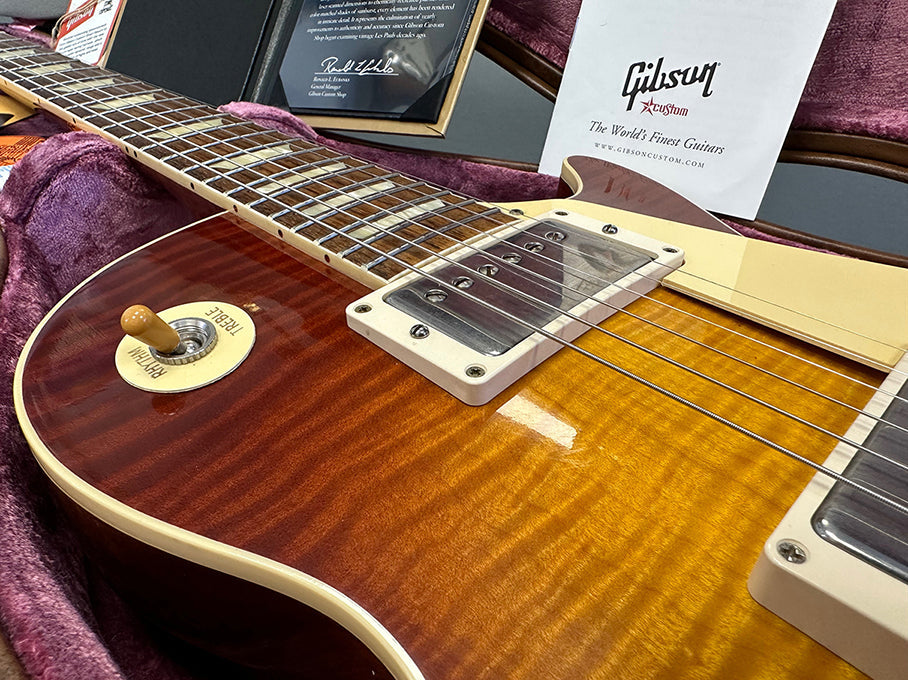
If you’ve spent any time looking at Gibson Custom Shop Les Pauls, you’ll know the same four years appear over and over again: ’57, ’58, ’59 and ’60. These aren’t random model numbers. They represent a four-year run in Gibson’s history that accidentally produced the most legendary electric guitars ever made. Ironically, they didn’t sell well at the time. In fact, they weren’t “legendary” at all — they were discontinued in 1961. Yet here we are, over sixty years later, still totally obsessed with them.
If you’re trying to choose between these four reissues, this guide will give you a clear sense of what each one really is, how it feels, why it matters, and — crucially — which one is likely to suit you best.
How We Got Here: A Short History of 1957–1960

It’s worth briefly revisiting what actually happened in those years, because the modern Custom Shop models make a lot more sense once you understand the original timeline.
1957 was the final Goldtop year and the first full year of the PAF humbucker. There was no Sunburst model yet, just beautifully made Goldtops with thick necks and a tone that defined the sound of blues rock before blues rock existed. You can draw a line from these guitars straight to Eric Clapton’s early work, Duane Allman, and the entire British blues boom.
1958 is when the world first saw the Cherry Sunburst. Tops were usually plain, finishes were strong and vibrant, necks were still fairly chunky, and production numbers were tiny by modern standards — roughly six hundred instruments.
1959, of course, became the grail year. The tops started to show dramatic flame, the finishes were gorgeous, the necks matured into what many consider the perfect carve, and only around 635 were made. These are the guitars associated with Page, Kossoff, Bonamassa, Slash and countless others.
By 1960, sales were so bad that the model was essentially on its way out. The necks slimmed down considerably, the top colours shifted toward brighter reds, and these final guitars eventually gained fame thanks to Clapton’s “Beano” Burst and Mike Bloomfield.
That four-year period, which the market barely noticed at the time, became the most influential run of solidbody guitars in history.

What the Custom Shop Is Actually Reissuing
Gibson’s Custom Shop built its reputation on recreating these instruments with as much historical accuracy as possible. Modern buyers will typically be choosing between:
-
R7 (1957 Reissue Goldtop)
-
R8 (1958 Reissue Plain-Top Burst)
-
R9 (1959 Reissue Flame-Top Burst)
-
R0 (1960 Reissue Slim-Neck Burst)
You’ll find each of them available as VOS, gloss “as new”, and Murphy Lab versions ranging from lightly aged to ultra heavy relics.
The good news is that all four play in the same league sonically — but each has its own personality.
Neck Profiles: The Theory vs. The Reality
If you’ve researched these guitars online, you’ve probably seen neat tables showing the “correct” neck profiles for each year. In theory:
-
A ’57 R7 should have the chunkiest neck
-
A ’58 R8 is slightly less of a handful
-
A ’59 R9 is the balanced “Goldilocks” carve
-
A ’60 R0 has a slim 60s profile

And all of that is true in theory.
In practice, Gibson has built these reissues across multiple eras with multiple builders, and neck profiles do vary. You can absolutely find a slender R9, or a surprisingly beefy R8, or an R0 that feels more like a late-’59. This isn’t a flaw; it’s simply the nature of hand-finished instruments built over a 30-year production span.
The takeaway is simple:
Don’t buy a Custom Shop on paper specs alone.
The individual guitar in front of you matters more than the model number.
The Character of Each Model
1957 Reissue (R7 – Goldtop)
If you like a big neck, you’ll probably bond with an R7 instantly. They feel solid, reassuring, almost old-world in the best way. Tonally, Goldtops often produce a thick, warm, woody sound with a slightly rounder attack. They tend to be incredible value because the market for Goldtops is smaller than for flametops — yet sonically they’re every bit as good, sometimes better.
1958 Reissue (R8 – Plain-Top Burst)
The R8 sits in a sweet spot for many players. You get a Burst, but without the flame premium, and the neck is usually big without being excessive. Tonally they’re open, clear and organic — the sort of guitar that feels honest rather than flashy. For many people, the R8 is the sensible and musically rewarding choice.
1959 Reissue (R9 – Flame-Top Burst)
The R9 is the headline act. It’s the most collectible, the most consistently sought-after, and typically the most expensive. The neck shape is different enough from the R8 to be noticeable, often with a lovely taper that just feels right in the hand. Tonally, great R9s have a dynamic, articulate quality that responds beautifully to pick attack. A very good R9 has a certain sparkle and complexity that people chase for years.
1960 Reissue (R0 – Slim-Neck Burst)
The R0 is a different beast. If you prefer a slimmer, faster neck — or you simply can’t get along with the chunkier 50s profiles — this is where you should be looking. The attack is slightly brighter due to the reduced neck mass, and these guitars can feel a little more modern without losing the PAF character. Clapton’s Beano Burst was a 1960, which should tell you everything you need to know about what these can do in the right hands.
Prices and Resale Values (UK Market)
R7s and R8s are where the best value lives. You will typically find R7s between £2,800 and £3,500 and R8s in the £3,200 to £4,200 range. These hold value well, but don’t tend to appreciate as fast as the more collectible models.
R9s command the premium: £4,500 to £7,500+ depending on the figure, top colour, condition and whether it's a Murphy Lab. These are the most liquid in the market — they sell quickly and often at stable prices.
R0s generally sit around £4,200 to £6,500 depending on the era and top. Demand is slightly lower than for R9s because of the neck shape, but among players they’re incredibly desirable.
Murphy Lab models can add anything from £800 to £2,500 depending on the ageing level and desirability of the individual guitar.

Which One Should You Actually Buy?
Your hands will tell you more in ten seconds than any article will, but here’s the honest breakdown.
If you like fat necks and adore the Goldtop aesthetic, an R7 is a brilliant, musical, often undervalued choice.
If you want the Burst look without paying the R9 premium, and you prefer a more understated vibe, the R8 is difficult to fault. Many seasoned players quietly prefer R8s because they deliver the goods without the hype.
If you want the closest thing to the mythical Burst, and you want strong resale, the R9 is the classic choice. There’s a reason it’s the most famous year in Gibson’s history.
And if you want the fastest neck and a slightly brighter, more modern response, go for the R0. It’s the sleeper choice for lead players.
The most important thing to accept is that the individual instrument matters more than the label on the COA. Two R8s can feel totally different. A killer R7 will easily outperform an average R9. And a great R0 can turn someone who “doesn’t like slim necks” into a believer.
Final Thoughts
Whichever model you choose, you’re buying into a remarkable legacy. Between 1957 and 1960, Gibson inadvertently created the most iconic electric guitars of all time, and the Custom Shop has spent decades refining its recreations of them. Whether you prefer the muscular swagger of a Goldtop, the understated vintage charm of a plain-top Burst, the flamboyant confidence of a flame-top, or the sleek feel of a 1960, there’s no wrong choice — only the right one for your hands.
And when you open the case and hit that first chord, the model number won’t matter nearly as much as the feeling that the guitar is you

About the Author

Coffee House Guitars is owned and run by Julian Deverell, who's been playing, buying, selling, and collecting guitars since the 1990s.
Julian has owned hundreds of guitars and has extensive knowledge of Fenders. He's passionate about high-end guitars and ensuring they’re set up and playing their best.